
S5E8 Maine Broadband Access Part 1: History and Infrastructure
In this episode, we discuss broadband’s history and infrastructure in Maine with Heather Johnson, Nick Battista, Clara McCool, and Andrew Butcher. Heather Johnson is the Commissioner of the Maine Department of Economic and Community Development, which works with statewide and local partners, private industry, and small businesses to enhance and sustain economic prosperity in Maine.
GPCOG Broadband Resources, Projects, and Programs
Transcript
[00:00:00] Clara McCool: Yeah, I think the one thing that I want to underscore from this discussion is just that I think Maine has really been a unique leader in emphasizing community engagement. And I think that has been really beneficial in the work that we’ve done as far as building up infrastructure across the state and will continue to.
[00:00:17] Eric Miller: That was Clara McCool, a panelist on today’s episode discussing broadband in Maine. Hello and welcome back to Maine Policy Matters, the official podcast of the Margaret Chase Smith Policy Center at the University of Maine, where we discuss the policy matters that are most important to Maine’s people and why Maine policy matters at the local, state, and national levels.
[00:00:37] My name is Eric Miller, and I’ll be your host. In this episode, we will be discussing broadband’s history and infrastructure in Maine with Heather Johnson, Nick Battista, Clara McCool, and Andrew Butcher. Heather Johnson is the Commissioner of the Maine Department of Economic and Community Development, which works with statewide and local partners, private industry, and small businesses to enhance and sustain economic prosperity in Maine.
[00:01:02] Heather resides in her hometown of Skowhegan and is a graduate of the University of Maine. Her career spans the private and public sectors and has included roles in global telecommunications, rural economic development, and broadband expansion in Maine. As the Island Institute’s chief policy officer, Nick Battista provides proactive and strategic policy support for work across the organization, providing strategic support to their project teams, and increasing their effectiveness in engaging policymakers.
[00:01:30] He helps teams identify and take advantage of opportunities to help set the policy agenda at the state and federal level, identify changes to government policy, funding, or regulations that would further specific community outcomes, and help achieve organizational impact targets. He also helps teams engage in the implementation policy so that it better accounts for the concerns of island and coastal communities.
[00:01:55] Clara McCool is the Regional Broadband Program Manager at the Greater Portland Council of Governments, also known as GPCOG. She engages with and supports community-driven broadband planning to help foster regional coordination to maximize broadband solutions. Her current work focuses on the Cumberland Oxford Lakes Area Broadband Collab Initiative, a multi-town strategy including five towns for the development of a broadband plan to address short-term connectivity needs and long-term infrastructure opportunities.
[00:02:28] She also manages GPCOG’s digital equity program, working to ensure that all Cumberland County residents have the resources and support they need to connect to the internet. Andrew Butcher is the inaugural president of the Maine Connectivity Authority, MCA, the quasi-governmental agency charged with achieving universal access of affordable, high-speed broadband throughout the state of Maine.
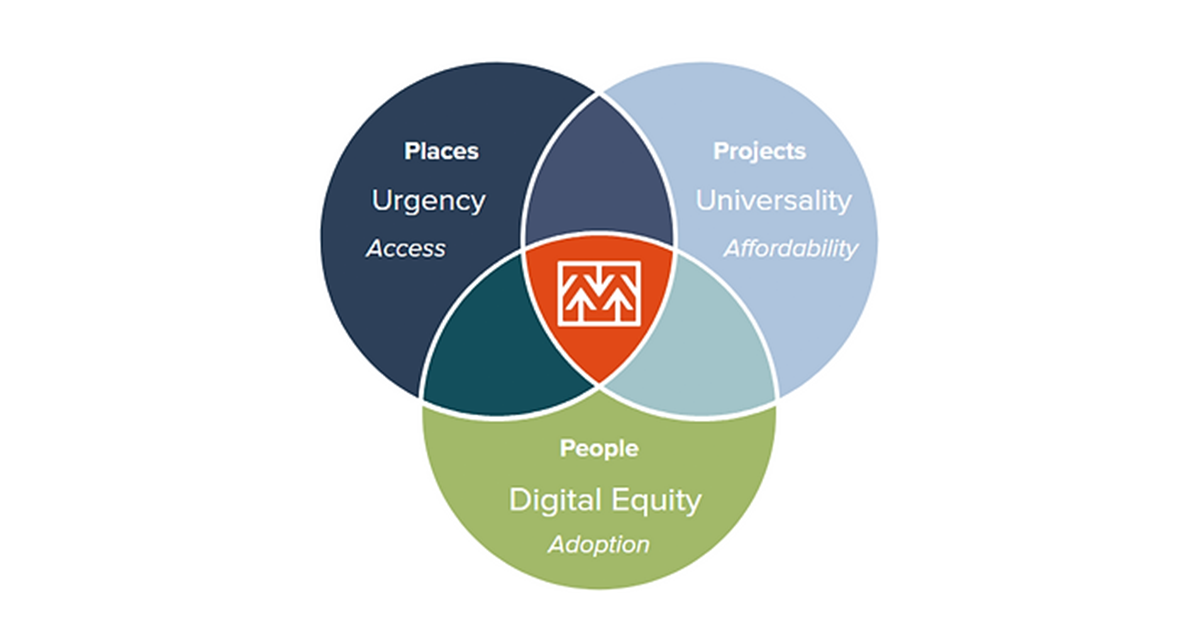
[00:02:52] By balancing investments in projects, places, and people, MCA is advancing digital equity for all. Butcher has over 15 years in community and economic development, social entrepreneurship, and connected infrastructure. Prior to his role at MCA, he founded and ran an internationally recognized nonprofit, served as director of the Maine Broadband Coalition and helped advance numerous innovation and resilience initiatives in Maine.
[00:03:19] He lives in Portland with his family and is known, to his children at least, for repairing the family waffle maker and listening to reggae while making said waffles. Internet access has revolutionized the way we live and has become a universal necessity in the 21st century. Connecting to the internet can be accomplished multiple ways, but no matter which pathway, vast infrastructure investment is necessary.
[00:03:44] Broad bandwidth or broadband, is a transmission system that enables rapid data transfer between network devices, facilitating a high-speed internet connection. It has become so commonplace in our daily lives, it can easily be taken for granted how much of our society and economy depends upon broadband and the policy frameworks that ensure broadband access for everyone.
[00:04:07] In June of 2024, Governor Janet Mills announced a federal approval to invest 272 million in broadband infrastructure funding, saying, quote, reliable internet access is a critical part of ensuring rural states like Maine can fully participate in our modern globally connected economy, end quote. Because the shift from dial-up internet to broadband technology is still relatively new, there are not yet set standards for what universal broadband adoption could look like. However, it is known that fast internet connection benefits the labor market, education, telemedicine, government services, and much more. As the world transitioned to online platforms during the COVID-19 pandemic, the need for reliable and accessible internet connectivity increased.
[00:04:56] A Pew Research Center survey on the importance of the internet during the pandemic conducted in April of 2021 concluded that 90 percent of adults say the internet has been at least important to them personally during the pandemic and 58 percent claimed it to be essential, an uptick from 53 percent in April, 2020.
[00:05:15] In the post-pandemic era, working remotely has continued to increase and become preferable to some. Broadband’s ubiquitous role in our society shows just how much we’ve come to rely on it and how important it is for anyone who wants to access it can use it no matter where they live. And now, our panel discussion on broadband infrastructure in Maine.
[00:05:38] Hello everyone, thank you for joining us today. So the internet is a relatively new technology, and to set the context of the rest of our conversation, why is the internet, and connectivity to it, considered a necessity nowadays and why should it be invested in Maine to the tune of hundreds of millions of dollars?
[00:05:57] Heather, we’ll start with you.
[00:05:58] Heather Johnson: Yeah. Thanks, Eric. The internet is, for years, we thought it was an entertainment vehicle. And the more that we develop on the internet, the more crucial it becomes and just becomes a natural utility, basically in people’s lives, right? Your ability to access healthcare, your ability to access information, right?
[00:06:17] If you think about where you get news, even from now, is all evolving, your ability to connect to other people in your family or in your communities. Public service options now are available online, which removes transportation barriers and opens doors for people who have other challenges. And so really what we’ve seen are the usages.
[00:06:40] It’s the usage of the Internet that has changed its necessity level versus the function of the infrastructure itself.
[00:06:49] Eric Miller: Yeah, it is incredible to think of how normalized how we go about our everyday and how engaged and guided that is by our connectivity to the internet. Nick, do you have anything to add to how and why some of the internet infrastructure is being invested in, to the degree that it is?
[00:07:07] Nick Battista: Yeah, so Island Institute is a 40-year-old community development organization. We work with Maine’s island and coastal communities on a variety of issues and we work with them to boldly navigate climate and economic change and expand opportunities. For us, we got into internet and helping communities figure out how to get better internet around 2015, because the people that we were working with in these communities were telling us stories like they couldn’t be on a zoom call, they were running their small business, an artisan maker was running her small business, and she was taking pictures of her pottery and then hopping on a ferry and going to the library, uploading the pictures to her website, hopping back on the ferry and going back home. And by the time she got home, sometimes all of her wares would be sold. And so she’s taken a day out of her life to ride the ferry to go upload something online because her community had internet that was so poor.
[00:08:09] It didn’t support that, what we think of as basic functionality. We had other businesses who are struggling to run credit card machines. You had to pay in cash because the credit card machine wasn’t particularly reliable. So for us, we heard these challenges. We heard that people wanted to stay in their community longer. Older folks wanted their grandkids to come and visit them and with no internet, the visits were much shorter.
[00:08:37] People who were seasonally part of the community wanted to stay into the winter but couldn’t because of work requirements, or wanted to be able to talk with their grandkids. So for all of these community and economic development reasons and challenges we were hearing from these communities, said great, better internet is a really good solution. And so for us at the Island Institute, it’s less about what is the wires or the infrastructure, or what does it do? It’s what does that internet enable for? Communities for people in Maine. And how do we help people take advantage of that? And it’s great to have so many communities already have a world-class internet connection in rural parts of the state, done great work on that.
[00:09:22] And we’re seeing the dividends of those investments a few years ago, start to be paying off and what’s possible in these communities now that wasn’t possible a couple of years ago and wouldn’t have been possible without internet.
[00:09:36] Eric Miller: I find that anecdote about enticing the grandchildren so charming. When you, people talk about social connection with the internet, that maybe think go right to Facebook and those types of things, but not necessarily an intergenerational connection quite like that.
[00:09:50] Clara, as someone that works in the Greater Portland Council of Governments, we hear from Nick, the like very rural isolated island connection element to it. From your perspective, why has the internet in a more urban and of course, the greater Portland area has some rural elements too, but why is it being, why is it so important in.
[00:10:11] Clara McCool: Yeah, so just to give some context, the Greater Portland Council of Governments, also known as GPCOG, we’re a regional planning organization serving the Greater Portland region, Cumberland County.
[00:10:21] We have a number of member communities that pay dues to us, and then we sort of provide different planning services and coordination with sustainability, transportation, housing, economic development, and our more recent work has been in broadband and digital equity, which is the work that I do.
[00:10:37] So initially sort of similar to Nick, I think the thing that pushed us into this work was our more rural part of the county. So in the Sebago Lakes region, there are a lot of individuals that a lot of towns you see the internet infrastructure really focused in the center of the town, but then you get out to those more rural areas and people did not have access to the internet, causing a lot of issues that Nick already outlined. And I think more recently, as more funding has come in to sort of bridge that gap in infrastructure, we’ve seen more of the need for internet equity in the urban areas. So if you’re in an urban area like Portland, there is a lot of infrastructure there.
[00:11:17] There is the internet to connect to but I think the thing that we see as barriers in the Portland area is it comes down to affordability, access to devices, sort of the digital literacy side of things. And so I think that’s sort of where we’ve focused on in those areas. And I think when you look at the urban part of Portland, there is a high density of vulnerable populations. And I think a lot of them, what we’ve learned the past couple of years working with those populations is the internet is absolutely crucial to accessing benefits, public services, trying to find housing, employment, economic opportunities.
[00:11:50] We have the largest population of refugees and asylum seekers in the state that are landing in Portland. And in focus groups with them, we sort of heard that the internet can be really crucial to becoming comfortable in a new space. So figuring out how to get around sort of what resources there are, how you can connect with communities that already exist to find new resources like housing and other options like that.
[00:12:15] So I think that’s something that we’ve really been focused on and something where the internet, it’s really important. I remember I heard a story of individuals who, it’s as simple as checking your bank account. I know an individual who needed to move some money around and had to stand in line at a bank for hours.
[00:12:29] And that takes a huge part of your day. Whereas if you had a device and a reliable internet connection, you could just pop on and check your bank account, move something around. So something as simple as that ends up becoming like this big ordeal that takes hours out of a already really busy day.
[00:12:43] Eric Miller: Since you mentioned digital equity, I’ll quick do a plug and teaser for part two of this conversation, which we’ll be talking about digital equity at length. So stay tuned for that one. But I was really interested at some of the Maine Connectivity Authority’s educational materials and showing that even in places, York and Cumberland counties, that people often refer to as like a greater Boston, still has, some absence, complete absence, or just slow connection available, to folks, which I found to be really interesting.
[00:13:14] Andrew, do you have anything to add on to this question about, we’ve covered a lot of ground already on why so much money should be invested in internet connectivity?
[00:13:24] Andrew Butcher: There’s good ground covered and I think it is certainly from the Maine Connectivity Authority standpoint as the agency tasked with planning, investing, developing, and supporting our digital infrastructure.
[00:13:39] It’s hard to understate the significance of the access challenges in a state like Maine, where we have such a significant amount of space and a relatively small amount of humans. And relatively challenging landscape and topography to work with. And so simply focusing on access alone has, could be an entire focus of a generation in how we string cable and wires on poles, build towers, amplify radio signals.
[00:14:11] And so that’s a huge amount of work in its own right. But as we were just talking about, one, does it reach everywhere? And two, once it reaches places, does everyone really have the ability and knowledge and tools to use the resource? Frankly, even thinking about my father-in-law just turned 80 and finally got a smartphone.
[00:14:32] And he’s a savvy guy and he has been going through his struggles with the smartphone and we were navigating the Department of Inland and Fisheries mobile app to purchase our fishing license. It was, first of all, one of the best examples of available digital services to support civic participation in the state.
[00:14:53] It’s a great tool because it’s designed for people who are likely lakeside and getting ready to purchase their license and need to be able to do it quickly. So it is really intuitive and the joy that I witnessed my father-in-law have using his smartphone to purchase a fishing license and understanding what that access is really helped illustrate the types of ways in which the availability and the access combined with knowledge of how to use the tool, allow for people to do the things that they live in Maine and love in Maine to do. And so certainly a huge amount of our work continues to be around how to enable access. And there’s really amazing progress to speak to on that front, but pairing that with considerations around how people are going to use it as commissioner Johnson referred to has infinite opportunity and possibilities.
[00:15:43] Eric Miller: Yeah, that’s a really sweet story and really illustrates how technology can apply to save people time and inconvenience factor. Andrew, since you’ve mentioned some of the physical infrastructure, that’s a nice segue into the next question, where we would like to unpack some of these different working parts of the broadband sector, and how does broadband infrastructure work as a whole system, both those physical elements and as well as the public and private entities that manage it.
[00:16:11] I’m sure we could discuss this for a long time, but Andrew, would you mind discussing some of those working parts and who’s doing that managing?
[00:16:20] Andrew Butcher: Sure. I will start with a high level overview, and my bet is that Commissioner Johnson and Nick and Clara will all have really important parts to augment.
[00:16:29] And so I think just at a high level, it’s useful to recognize that broadband infrastructure, really broadband, high-speed internet that provides internet service at a high level of performance, allowing for us to not just download content, but be able to upload content. So our ability to participate, all 5 of us on a zoom meeting, hearing and understanding and seeing each other in real time is due to the ability to upload data, which is effectively beams of laser shot through fiber optic cable, the size of a human hair across the state. And frankly, across the country and across the world, the digital infrastructure is so present sometimes most of us don’t really even see it.
[00:17:18] But as we think about the components of the ecosystem that are important to our work, it really comes down to the physical infrastructure of the poles, the fiber optic cable, the towers, the amplify signals, and the internet service providers or the ISPs that are the entities that provide that service. And in some cases, even public entities or municipalities that enable that type of internet service.
[00:17:48] Even in Maine, we have mechanisms to allow for multiple municipalities through a regional collaboration of what’s called broadband utility districts to be able to collaborate and find efficiencies as municipalities to be able to provide access to those services. So the starting point is really on the physical infrastructure, the internet service providers that are packaging that laser and amplifying it through equipment to homes and businesses to be able to get online.
[00:18:20] But there’s also in Maine, we’re really fortunate to have a very robust network of regional planning organizations, nonprofits, subject matter experts, state agencies across multiple disciplines that have recognized how important investments in the infrastructure are for telehealth, education, remote working. And so there’s a robust network of entities that have been working together for over the last decade in advocating for a better internet, helping educate people around digital literacy. And so that is what I think we often refer to as an ecosystem that constitutes a really important part of how we get the work done. But I’ll pause there and see what I’m missing.
[00:19:05] Eric Miller: Yeah, that was a fantastic high-level overview; the high-levelness is much appreciated.
[00:19:10] Heather, would you like to continue on with with your thoughts?
[00:19:13] Heather Johnson: Yeah, one of the great things about a state like Maine is when you can see real value in something and Maine people see real value in something, you can all rally around it and kind of mobilize toward it. And I think we have some great internet service providers and partners.
[00:19:28] In our state with local communities that are really involved in saying, look, this is the, this will help create vibrancy for our community. This is an important piece. And then we have residents saying, I want to live where I want to live. And the universe has changed enough that now I can actually make that decision, but I can only make that decision if I have access.
[00:19:45] And the global marketplace has driven that some, but this collaboration between agencies and organizations that are getting federal funding, communities, residents, and internet service providers, all kind of working together to the goal has been a big part of the success that I think Maine has seen over the course of the last few years.
[00:20:04] And in moving forward pretty quickly, we talked to internet service providers who have said, we see the path that you’re all they’re taking. And so we’ve adjusted our construction schedules to prioritize Maine. Because your communities are interested and they’re helpful. We see residents caring a lot and coming out and helping.
[00:20:21] We had a bucket truck in the town I live in, and I drove by and somebody was bringing them coffee. Cause they were so excited that they were about to have fiber coming to their home. They were standing beside a road with coffee for the people that were working on the lines. And as you think about that engagement and our ability to be really direct and clear about here’s who’s not connected and here is who’s connected.
[00:20:42] And here’s how we’re going to move that forward and make it valuable for all Maine people. You know, Clara, I think you had a great point about vulnerable populations and making sure that people have access and can create value, right? So there are multiple tiers here, and you’re going to do another thing on digital equity.
[00:20:58] So I won’t go into that, but I think it’s really important that infrastructure is step one of, and this collaboration to get there. It’s a really key part of how we get that done effectively.
[00:21:08] Eric Miller: Yeah, I feel like there’s a lot of ill will toward internet service providers, largely in dealing with long call times and what have you. And so it’s nice to get some sort of an uplifting tale about that. Yeah. Andrew.
[00:21:23] Andrew Butcher: Yeah, thanks. I think that actually, Eric, really illustrates a important point that I think I just heard Commissioner Johnson emphasize as well and that people really care. And the pandemic really revealed that for us all of just how important it is to be able to get online and connect with others for a variety of reasons.
[00:21:45] And I think it’s fair to say that all of us on this call have some sort of foundation in community development, and that has very much been informed by and contributed to what I think is a Maine model. And, we all have eyes on this from a national standpoint, but Maine is regarded as a real leader in embracing a community-driven community-informed process, which means that where there are equipped and informed and engaged people, they drive demand.
[00:22:16] And with internet service, that, in a rural place like Maine, that aggregated market is a really important ingredient in facilitating a partnership with a private entity who’s willing to invest their own funds. And so that Maine model I think reinforces how much people care and also why we have high standards for how we work with industry partners and how we design programs and how we try to maximize the value of the investment ’cause it’s gonna have to be something that works for a long time to address a lot of needs.
[00:22:51] Eric Miller: Yeah let’s dig into some of the more local stuff. And we’ve got Nick and Clara here to illuminate us on how their organizations worked with various entities to bring internet to places that need it.
[00:23:04] Nick, would you want to start us off with talking about how getting some of that physical infrastructure to the grandparents that wanted to get their grandkids?
[00:23:14] Nick Battista: So Island Institute, we work primarily with island and coastal communities. These are often more of the remote coastal communities Downeast, and Washington county.
[00:23:25] And so one community that was an early leader in the internet conversation was the Cranberry Islands. And part of what we did at the Island Institute with a very engaged set of community partners was say, okay. You need better internet. Here are some different pathways and options that you can go down and to help the community figure out which pathways to go, we encourage them to set some goals about what they wanted at the end for their internet service.
[00:23:56] And, they talked about things like if we’re investing public time and resources and funding into this, we want it to serve everybody. We want everybody to have the same access to the internet. We don’t want your physical location in our town to determine the quality of your internet or determine whether you have internet at all, because it’s so important to our town, we need everybody to be served. And they’ve worked through that process and ultimately decided for their community, if they owned the infrastructure itself, they could hire an internet service provider to provide the internet service, to light the fiber, to provide the service, to do the billing, all of that, the community would own the asset. And they would end up having service.
[00:24:43] I think one of the challenges that’s been pretty apparent in this work is much of the internet infrastructure in the state is owned by private businesses. And so you have private businesses making investments in the infrastructure itself. That’s a pretty significant capital investment. Thinking about how you incentivize those investments, it starts, there starts to be a couple of different models that come to the forefront. And for some communities, maybe there isn’t a private sector provider who wants to make that investment in that community.
[00:25:16] It’s just, there is just no return on their invested capital. If the community invests in it, then they don’t have to worry about that private sector provider getting a return on their capital. And so that was one way we helped some of these small communities deal with market forces.
[00:25:33] We also worked with Long Island, which is down near Portland, and helped them connect with their existing telephone provider and used the energy in the community and that community process and all of the excitement that Andrew and Heather were talking about to help the community understand what they needed to do to work well with their existing provider and we help the existing provider understand how to work with the community to expand.
[00:26:05] And so the state invested a small, a modest amount of money in that project. And the existing telephone provider built a world-class fiber network on the community because the community was interested and engaged. And so both the Cranberry Islands and Long Island now have two very high-quality internet infrastructures.
[00:26:26] They look different in terms of who owns it, who controls it, but they got there in the same process, which was defining what the community needed and then figuring out how to work with the right set of public and private partners to go there.
[00:26:40] Eric Miller: That’s really interesting. I’ve never heard of people owning some of the infrastructure themselves that then allows for a service provider to actually just give the service without that investment. That could be an interesting model for other more isolated communities.
[00:26:55] So Clara, your situation is a little bit more different as you’re more inland. And so when you are navigating some of the physical elements of the infrastructure and getting internet to folks, what do you all have to navigate in terms of engaging with public and private entities to get internet to people?
[00:27:11] Clara McCool: Yeah, so it’s definitely a bit of a different challenge in our urban and rural areas. As far as our rural, the more rural part of the county, we’ve been engaged in supporting a regional broadband effort for the past, I guess it’s been about three years. Back when I started at GPCOG, I was working with a town in the Sebago Lakes region, Harrison, and a couple of other towns that had gone through a broadband bootcamp that was put on by an organization called Maine West. It was basically a 10-week program to help get communities up to speed on what is broadband? What does it look like for a community to be involved? What are the internet service providers that could come and build out in your region?
[00:27:50] So it was basically, yeah, a way to get community members, community officials involved in the broadband planning process. So we had a couple folks at GPCOG working with different towns, realized that all the same questions were coming up and figured it maybe made more sense to convene a group and work together on a broadband solution.
[00:28:08] So doing that, we were able to bring on a consultant. A big part of the work that we did with them was sort of what Nick was talking about, where a big step in the broadband community-driven broadband planning process is identifying what a community’s goals are. So GPCOG is really great at bringing groups together, identifying resources, bringing in sort of information to help them make the best decision.
[00:28:31] But at the end of the day that we really want the towns to be in the driver’s seat of what their community needs. So with that group, we interviewed different internet service providers. And in the end, they came to sort of a similar place to where next communities were, where in the past, the internet service providers had come in fully private built out where the demand was, but there was no sort of service-level agreements.
[00:28:53] They had no control over the service-level agreements that were made. And the communities that we were working with really wanted to make sure that they would have certain speeds and that they could have a relationship with their internet service provider to have customer support, sort of have some sort of control over prices and the service-levels that they were getting.
[00:29:10] So they ended up partnering with a smaller internet service provider that is local to Maine so that they could sort of be in that driver’s seat. And they have a right of use over the network that connects their municipal buildings, which is really great. So all of their municipal buildings can be on the same network.
[00:29:24] But it was definitely, it was a long process, but I think the reason that we came to the decision that we came to, or that the communities came to, is because they were sort of in the driver’s seat, making those decisions the whole way through and really engaging their community, putting out surveys to figure out sort of what the needs were.
[00:29:40] So in the more rural region, it’s really been engaging with internet service providers and making sure we understand their plans and sort of what they can offer the towns and then making sure that the line of communication is always open between community members and those internet service providers.
[00:29:54] In the more urban areas, this is a bit of a more complicated question about how to get internet service to folks that don’t have it because it’s less of connecting to the infrastructure and it’s more an affordability issue. So working with folks that maybe would need a hotspot so that they can get service temporarily until they can potentially identify a solution to afford the internet.
[00:30:15] But I think that it’s a bit more complicated, in a different way, I would say in our urban regions. So it’s, a lot of times it’s working with libraries, adult education centers, and sort of GPCOG being that entity in between the state and federal funding sources so that we can try to figure out how to distribute funding in our region so that individuals can have access to hotspots and that type of internet support.
[00:30:39] Eric Miller: Sure. Yeah. As I reflect on this conversation we’ve had, I can’t say I’m too surprised by this, but I am amazed at how powerful communities advocating for themselves has been in order to spread access and the difference between rural and urban divides facing different challenges is really interesting to me. But it really shows how powerful small groups of people are when they come together on a common cause.
[00:31:06] So I’d like to dig into some of the funding elements because there’s been a large amount of federal investment and recently Governor Janet Mills announced the approval of Maine’s plan to invest 272 million dollars of federal funds in broadband infrastructure. And I’d like to know how this influx of money will change how the Maine Connectivity Authority will go about their work and how exactly will that funding manifest on the ground and impact Mainers. Commissioner Johnson, if you wouldn’t mind taking the reins first.
[00:31:36] Heather Johnson: Yeah, I can start that one and everybody plays an interesting role here. So I think it’s really clear right, in a state like Maine where you want to support all of our communities, making sure that access is available to anyone who wants it is like a number one priority of the Governor’s, who’s really been very direct about that goal and mission that by the end of this year, people would be able to have access.
[00:31:58] Now, that doesn’t mean it’s the final step, it means some sort of access, we’re going to keep working to make sure people have better access and improved access and the reality is, there’s no end to the need, right? If you look at the amount of data people use and the use cases, right? The more complex they get, the more data throughput you’re going to need. And so this will be an ongoing body of work, but just to make sure people have a start is right, a key step, because you don’t want to leave rural communities behind in this discussion, there’s been a lot of work done and I’m going to go back a little bit, Eric, on this one.
[00:32:31] About six years ago, we didn’t know what was covered and what wasn’t covered. And so there was no infrastructure on the back end, no mapping that was able to be looked at to say, Okay here’s where our gaps are. And to Clara’s point, sometimes there were four streets in a community not covered, but most of the community was covered.
[00:32:51] And so to create critical mass in a community to get that problem solved is difficult. And so now fast forward, we invested early on some federal funds that we were awarded a grant for, to start using mapping software tools that then said, Okay, now we can start to see what’s going on here. We can see where lines dead-end.
[00:33:12] And it’s hard to keep going through there. We can see where there’s too many people for the capacity we have. So even though, sure, if you look at the poll, there’s something on the poll, but there’s not enough infrastructure to support the users in that space. So having that knowledge as a base allows you to be significantly more efficient with your funding.
[00:33:31] Because you know exactly what you’re trying to do. And you can negotiate things like how many people will connect to this. Therefore, what does the business model look like for the private sector? And then what do we need to do to encourage people to go to the more remote places? Maybe the places where you’re not going to get as good of a take rate because either people aren’t able to afford it, maybe there’s not been a lot of value there, or it’s just really expensive. Because their houses are very far apart.
[00:33:59] And so that’s really allowed us collectively to be much more strategic about those builds, and to say, Okay, those actually don’t need any subsidy, these need a little subsidy and these need a lot of subsidy. And so as you combine those together, you can work on effective packages and I think one of the advantages of the Maine Connectivity Authority is really their ability to look at the detail in partnership with internet service providers and communities, depending on who’s going to own it would change who’s at the table, but it really allows the Maine Connectivity Authority to get under the financial aspects of the project and really be great stewards of taxpayer money and get the entire state built out.
[00:34:37] So it’s this really interesting balance of being super careful with every dollar and really looking at how do we make sure everybody gets connected, but that we do it in the most cost-efficient way possible, really looking at before we had mapping, we might build in the next community, leave these people in between two service centers out, and then connecting those is incredibly hard after the fact.
[00:35:01] Nick’s laughing because we, we would see that afterwards, and we didn’t know that was going to happen. And so there were really efficient models now that the Maine Connectivity Authority can put together working with partners and communities to try to figure that out. So there’s been a real evolution in how we invest those dollars to make sure everybody in Maine is covered and some much better partnerships with service providers and communities to get there.
[00:35:27] Nick Battista: I would just jump in and say, I think Heather deserves a lot of credit here because she developed a broadband plan for the state about six years ago that identified this need for better mapping, and really set the table for both the community planning that happened and for the mapping work. And the need to do that, I think, was driven in large part by the fact that at that point in time, the state was investing about a million dollars a year in connecting those people who didn’t have much of a connection.
[00:36:00] And we had over 80,000 homes at that point in time, that didn’t have a connection. If we’re connecting a couple hundred a year with that million dollars, it was going to take us a really long time to get everybody that connection. And so I think part of that switch that Heather was talking about was a switch in strategy and thinking to say, how do we invest limited dollars, for the greatest good? Not just for how many homes can we get past, but how did these dollars leverage private investment?
[00:36:33] Whatever we’re investing on the public side, there’s a significant amount also coming in from the private internet service providers. And leveraging that, building the ecosystems, supporting those community conversations, and that planning work put us in a situation where when federal money started to flow, Maine was right there and ready, and we knew what we needed to do to put together applications.
[00:37:00] We had the maps, we had the data, we had the ability to apply for federal funds. And I think one of the game changing investments that led to this 72 million dollars that you were talking about was a 29 million dollar grant from the NTIA in 2021 that connected six different projects that had all been going through this community process.
[00:37:25] And they were pretty much ready to go. They just didn’t have the money to build the infrastructure. And because the state saw the opportunity, packaged it together and said, we’re not going to do one of these projects. We’re going to do all six of these projects. And the state’s going to administer the money.
[00:37:41] We’re connected in that project or Somerville or Washington. They were going to struggle to meet all the federal requirements. But because the state could step in, package a bigger project, we were able to attract these game-changing funds to the state. And I think that set us up really well for this subsequent series of conversations.
[00:38:01] Andrew Butcher: I want to take a minute to just double click here because thinking about the likely audience of who’s listening here. There’s an amazing case study here of policy innovation that I think is really worthwhile. Two important components of that, but to tie it together when you think about it, Commissioner Johnson in her prior role was running the Connect Maine Authority, the state office embedded in the Department of Economic Community Development.
[00:38:29] I don’t know if we mentioned that so far. It was through that I believe that the broadband. plan was developed, a 2 million federal grant was developed for that data platform. That data platform was essential in identifying a better understanding of where there’s the need. That need became central part of a 2020 bond campaign where 75 percent of voters in Maine advocated for, and voted in support of dedicated state funding for investments in better internet, which was huge in 2020.
[00:39:06] And of course we were knee deep in the pandemic at that time. And it was because of that community-driven support that was data driven, the state through Connect Maine was able to be one of 13 awardees in a highly competitive federal program to get the 29 million that Nick was just referencing. And it’s worthwhile mentioning that as Commissioner Johnson evolved from her role at Connect Maine into leadership of the Department of Economic Community Development, Nick was also and is serving as chair of the Connect Maine board, both of whom coordinated and strategized around recognizing, all right, we’ve got some real fire here. How can we be as proactive and strategic as possible in being able to make the most of federal recovery, relief and infrastructure funding coming down the pike.
[00:39:58] And so in 2021, The legislation for the Maine Connectivity Authority was developed and approved through bipartisan support and in 2022, the Maine Connectivity Authority was operationalized and has effectively functionally integrated with Connect Maine so that there is a single entity responsible with a designation of being able to continue the work of investing in planning and data.
[00:40:26] And being able to facilitate and administer the federal funding. And so some people might have found that a strange backstory, but I think for the policy wonks right now, and we’re amidst various stages of deployment. And we can drill into it.
[00:40:41] Andrew Butcher: If you want, but you’d asked the question about sort of the scale of funding and where we’re at on it.
[00:40:46] And I think it’s sort of helpful to ground it in how things have evolved over the last couple of years. Funding through the Maine jobs and recovery program of 21 million to be able to get to work as quickly as possible to complement an additional 130 million of American rescue plan funds through the Capital Projects Fund.
[00:41:05] That’s 150 million dollars of American Rescue Plan funds for broadband infrastructure that we’ve deployed over the last two years and is in motion and is facilitating the development and construction and implementation of projects right now. And that has teed up the ability to implement over 300 million in bipartisan infrastructure law funds that are taking shape right now and we’re amidst various stages of deployment in, and we can drill into if you want.
[00:41:37] But you’d asked the question about sort of the scale of funding and where we’re at on it. And I think it’s sort of helpful to ground it in how things have evolved over the last couple of years.
[00:41:46] Nick Battista: I would just add Andrew, I think the other interesting wonky policy component to this, along with the scale of funding, right? The Connect Maine Authority in 2020 had a budget of about 1.5 million, 1.4 million and a staff of two, and a volunteer board of seven of us. In the pandemic, in the deep in the pandemic, the bond campaign, there were some other funds that Connect Maine where we’re working with 6 million to connect students that didn’t have a connection and couldn’t go to school because they didn’t have a connection and school was being held remotely.
[00:42:24] And so like kids need to go to school and we have to connect them through the, that Connect Kids Now project, and seeing this wave of federal funding looming on the horizon, I think it started to become pretty clear to those of us deeply involved in the Connect Maine Authority that as an institution, as a public policy institution, Connect Maine was going to struggle mightily to do all the things that we need to do to be ready for the 30 million opportunity in NTIA that came up for the, 150 million opportunity that Andrew just talked about. For the 300 million opportunity that’s coming that, Connect Maine was okay in the one to five, six, eight, 9 million range a year. But when we started talking about 60 projects across the state with significant federal reporting requirements, with needing staff, with needing to address workforce and digital equity and do community planning, not on an ad hoc basis, but across the state Connect Maine’s institutional structure and statutory structure was not going to let us get there. And so that led to the creation of the Maine Connectivity Authority as an institution designed to be robust enough and strong enough and have the right board for tackling this challenge, for meeting the moment in terms of funding and in terms of need and importance to the state.
[00:43:52] Also huge for Island Institute as a regional partner and really important for the communities in Waldo and Hancock County that we’ve been supporting that didn’t have a broadband committee going. The communities that hadn’t started yet in this process, and maybe weren’t going to ever start because their community is focused on other things, but still needed internet.
[00:44:17] And so the capacity to make sure those people were connected too is really important.
[00:44:24] Eric Miller: Thank you, for you all for such a intimate look into how funds were acquired and some of the inertia that allowed organizations to, dare I say, optimize that funding into, and it’s someone with a master’s in economics I greatly appreciate that and how that funding was deployed into infrastructure.
[00:44:44] Clara, do you have anything you’d like to add to this funding question, whether it’s how GPCOG acquires funds or, and deploys it?
[00:44:51] Clara McCool: Yeah, I guess one thing that I just wanted to add listening to this conversation, I think that the team that Andrew put together at MCA, it’s really big nod to the success that they’ve had.
[00:45:01] I think a lot of the folks that are working with MCA now to distribute funds have been people working in the broadband space for many years in Maine and who have put strong emphasis on that community-driven broadband planning process. And so I think that’s made a big difference in how the funding has been distributed.
[00:45:17] I know that GPCOG we’ve applied for a couple different grants with the Maine Connectivity Authority, one of which was a Get Ready Grant. So that’s for communities that maybe aren’t ready to build yet, but are still sort of in that planning process. And that funding was sort of what allowed the regional group to in the lakes area to get to the point of choosing an internet service provider.
[00:45:37] So I think putting emphasis and value on that community driven broadband planning process and not only valuing it, but putting funding into that, I think has been huge for us and for the community members in Cumberland County.
[00:45:50] Eric Miller: So I’m glad we’ve mentioned some of the things that’s happened with the development of MCA over the past six years or so, as technology and the way that people connect has changed a ton in that time as well.
[00:46:02] And so I’m really curious how wireless internet providers from cellular providers, Starlink even, et cetera, has changed how people get online. And how has that changed how policymakers and internet access advocates view the role of broadband as more people access the Internet.
[00:46:20] Andrew Butcher: It’s a great question, and it’s a nuanced one. I think from a starting standpoint, from the Maine Connectivity Authority standpoint, all solutions are on the table to address our connectivity needs and different technologies can be and should be complementary to each other. And the majority of the funding of which we’re responsible for has, requires the performance of the delivery of the internet to be at the highest possible standard for the longest period of time.
[00:46:53] And so one of the biggest evolutions is the ubiquitous availability of fiber optic cable to be able to deliver the highest speed possible upload and download service. And so the majority of recovery plan and infrastructure funding, public funding is looking for that long-term investment of the baseline infrastructure that allows for innovations and new technologies to be able to work from.
[00:47:21] So that is the primary level of technology of which our programs and our funding are oriented towards. However, everybody who uses a smartphone and travels around Maine recognizes that the ability to access wireless internet, the ability to expand cellular service is still a need. And so we’ve tried hard to identify partnerships and programs that can complement and be really strategic and targeted.
[00:47:48] We are amidst a pilot program called JumpStart to try out multiple different technologies, wireless technologies, in multiple places with multiple partners and understand some of the trade offs. One wireless technology that we had hoped to be able to utilize in Aroostook county community actually ended up not being feasible because of US-Canadian border restrictions on certain spectrum. And so that’s an important insight when we think about the types of technologies that can be useful in different places. We have an open RFP to select a low Earth orbit or LEO satellite provider to be able to provide a targeted service to the less than 1 percent of the state that really has no option for no service and no technology option. When earlier commissioner Johnson emphasized the significance of making sure no one’s left in the digital dark right now, and that can’t be underscored enough.
[00:48:46] And so when we look at less than 1 percent of the overall locations that have really no option in the short term, it’s going to take time to build anything to be able to get there. And so we need to make sure everyone has an option. And so resources and technologies like low Earth orbit allow for the delivery of internet in a box.
[00:49:05] And that may not be entirely a feasible option or an appropriate option for all locations in the state. But if we’re putting public funds into making sure that everyone’s able to have an option, that’s a great type of resource for us to be able to utilize for that need. So again it’s an all solutions on the table type of orientation for us.
[00:49:26] Eric Miller: Nick, as you have been engaging with coastal and island communities, have some of these technological changes changed how your constituency has approached getting access to the internet?
[00:49:39] Nick Battista: I don’t know if I’d say it’s changed how they’ve approached it, but it’s been a really big factor in discussions. Almost every community has looked at satellites, they’ve looked at wireless service, they’ve assessed whether it meets their needs. And some of them have said, yep, we think that could be the right pathway for us and for our community. But most of them are looking at the longevity of having good connectivity.
[00:50:07] And they tend to be communities that prioritize self-sufficiency and prioritize, knowing that their future is secure. So in the timeframes in these communities, if you’ve got good service for three years, that’s one thing, but they really want a 20 year solution, a 25 year solution, a 30 year solution.
[00:50:27] And that comes with more physical infrastructure and in wires. That’s where they’ve gotten to on their own after digging in deeply and assessing all of the options and some of them are using wireless to connect parts of their communities that don’t have that, some of the island communities have an island where most people are and then there may be another island or two that have a couple of houses and so they’re connecting those into the rest of the infrastructure wirelessly.
[00:50:55] It’s the solution that works for the community.
[00:50:57] Eric Miller: That’s really interesting how that works. And these options that never seemed to be on the table are all of a sudden there and can change the calculus.
[00:51:05] Clara, have you noticed, and you’re welcome to go into some digital equity elements of it, and I don’t think that’ll spoil the part two conversation. But since you mentioned it before, I’m intrigued by your perspective on the technological development and how that might play into a role of how people access internet and those maybe urban folks who have the internet’s technically there but the affordability element necessarily isn’t but they might be able to connect through their cell phone and if you just have anything else that you GPCOG has as you approach this technological change.
[00:51:40] Clara McCool: Yeah, I think definitely similar to Nick as far as in our rural regions that we’ve worked with, definitely had a similar experience of in assessing the different internet options, all of our communities that we’ve worked with have at some point entertained the idea of a wireless internet service provider for similar reasons to what Nick mentioned, sort of looking for that more, maybe more future-proof technology that’s really going to last 20, 25 years down the road.
[00:52:05] I think that’s what our communities have ended up wanting to invest in, but I do think that we’ll still see some people that will maybe get Starlink or something on their own, sort of their own solution that works for them. As far as the more urban areas I think there’s been discussion around finding more public spaces that could have sort of like a wireless internet connection.
[00:52:28] So maybe that would be the parks in Portland or different areas like that to try to bridge the gap for folks that maybe don’t have connection at home. I mean, some folks that we work with are really accessing the internet from their phone. And a lot of times they, especially new Mainers might not have a phone plan, so they might need Wi-Fi to access the internet on their phone.
[00:52:48] And so if they’re out doing something in town or somewhere in a public space, having that access to internet is really important. That’s sort of where we’ve run into it there but not so much in other ways, but I think, yeah, going forward, it’s definitely going to be a part of the discussion.
[00:53:02] Eric Miller: It’s interesting how the blend has come up and that makes absolute sense. I mean, everyone’s needs are different and solutions are most attractive.
[00:53:09] Heather, do you have anything you’d like to add to the technological frontier of internet access?
[00:53:15] Heather Johnson: It’s interesting, right? We all talk a lot about this. What’s the balance? Is there a future-proof solution? Is there a now solution?
[00:53:23] How did those fit together? But as a user, right? If I take myself out of this role and put myself as a user, before I took this role, I wanted to go from my house to my car, to my office, to the grocery store and I didn’t want to see any difference, right? And in urban markets you can do that, in a rural market you couldn’t do that at that stage. And so really thinking about it that way.
[00:53:47] I think most people, if you go out and pull people, I don’t know that they would, I think in general, as long as it works that’s what they care about, right? Like how it works. What system it is, what the back end is, right?
[00:54:02] People that sit on calls like this will debate that and talk about future-proofing and talk about kind of nodes and all of the things. But the reality is for users, the best experience we can create for people to have technology be a seamless part of their life that they can control in the way they want to, and shut off, frankly, when they want to.
[00:54:24] Like users control, technology doesn’t control the users and our ability to create that seamlessness for people in partnership, obviously with private sector providers who really are the ones that do most of that work. I think that’s the stuff that I try to stay focused on is not getting too worried about which technology element, as long as it’s seamless and it works.
[00:54:44] Eric Miller: Yeah. It’s interesting you frame it that way, because when I think about other utilities, such as water, no, one’s really concerned about how it gets to the faucet. As long as it’s there and it’s safe and turns on.
[00:54:54] Andrew, is there anything else you’d like to add on this topic?
[00:54:57] Andrew Butcher: That’s such an important perspective, that user orientation that Commissioner Johnson was just emphasizing. I call it sort of part of the subterranean universe of thinking about the internet, but the prioritization of allowing for options through investments in our middle mile and backbone infrastructure.
[00:55:18] And part of the reason I have to mention this, Eric, is because it’s only on the early stage of development, but MCA in collaboration with a handful of other entities, including the University of Maine, have received a 30 million competitive grant to expand and build out Maine’s Middle Mile infrastructure through what is known as the Maine Open Optical Statewide Enabling Network, or MOOSE Net.
[00:55:41] That is, from the technology, when we’re talking about new technology, all of the technological options that provide internet service all require the ability to transport internet over the highways of fiber optic cable, whether it’s to a radio tower, or whether it’s as a base station to receive satellite signals.
[00:56:03] And so one of the reasons why MCA and the Department of transportation and the University of Maine have collectively committed to investing in this project is that, that infrastructure creates options for us to diversify connectivity solutions on an ongoing manner into the future, which is key when we think about how are we ensuring participation, inclusion and new opportunities?
[00:56:31] And a variety of different types of services. And so there’s the sort of end points technology to be thinking about, but then there’s also the enabling technology, which is, I think, a key part of the strategy that we’re trying to embrace. And hopefully there’s exciting things to continue to report on, and especially given the role that Network Maine and the University of Maine have on that project.
[00:56:53] Nice. We’ll have to check
[00:56:54] Eric Miller: back in on that a couple of years down the road and have you all back. So thank you all so much for coming on the podcast today to discuss your roles in deploying internet and other reinvestments in the state to, and illuminating how it works and who has access and who will hopefully be getting a fast, reliable connection in the coming years and just gathering for a policy wonk in group discussion.
[00:57:21] So as we close out, if there’s anything that you all would like to mention that we haven’t covered yet, or how you view the future of internet access in Maine, as we close out, now would be the time, Clara, would you mind kind of starting us off?
[00:57:35] Clara McCool: Yeah, I think the one thing that I want to underscore from this discussion is just that I think Maine has really been a unique leader in emphasizing community engagement. And I think that has been really beneficial in the work that we’ve done as far as building up infrastructure across the state and will continue to. And I also think it’s really been important in the digital equity work that we’ve delved more into the past couple of years.
[00:57:58] And GPCOG is the regional and tribal broadband partner for Cumberland County. So we’ve been really focusing on digital equity the past couple of years. And I’m really excited to continue doing that work. There’s so much need, but it sounds like there’s more and more funding coming into the state to, to help close that gap, but yeah, just keeping the community members at the front of the conversation and those impacted by sort of the digital divide, I think is something that Maine has done really well and excited to continue doing in the future.
[00:58:24] Eric Miller: Yeah. I’ve just found that community-driven change thread of this conversation is just really inspiring as we’ve been chatting.
[00:58:31] Nick, do you have any thoughts as we close out?
[00:58:34] Nick Battista: Yeah, definitely agree with what Clara said. And then I think it’s hard to underestimate the magnitude of change that this sector has undergone in the last five years in terms of engagement funding, where we were five years ago to today is an incredible amount of change.
[00:58:51] Communities, public institutions, internet service providers, everybody involved is still trying to catch up with that change and understand it and navigate it. And then I think, one final thought for me is it’s the flip side of the digital equity question. If everybody in the community has a high quality internet connection, what is that enable in that community that we’re not thinking about? Particularly in a rural community that hasn’t had that kind of a connection.
[00:59:19] And so I know there are communities like Georgetown that are thinking about, wait, everybody’s got a connection or has a connection available. What then does that mean for our civic engagement, for our public institutions, for local economic development? What can we do because we all have internet together that we couldn’t do before?
[00:59:40] And I think that’s a really interesting frontier for the state, and we’re just now starting to ask those questions. I don’t know that there’s a ton of great answers out there yet, but I think Maine’s on the forefront of figuring out what’s possible in a rural community that has a high degree of connectivity that isn’t possible without that connectivity.
[01:00:02] Eric Miller: Yeah. And I think just asking the question is a huge start. The fact that forward-thinking enough of okay, we have this tool. Now, what are we going to do with it together?
[01:00:10] Andrew, do you have any closing thoughts for us?
[01:00:13] Andrew Butcher: Absolutely. Thanks so much again for the opportunity to have this conversation with you all in part, because the Policy Review, the Margaret Chase Center represents such a great opportunity for people who are interested in doing any research or supporting the dozens of partners that are doing incredible work along these lines, the Island Institute and GPCOG being representative of two of the 16 different regional and Wabanaki partners around the state. There are over a hundred active grants and awards that are in motion right now. All of whom are with community and regional and organizational partners that would benefit from support and impact evaluation in dedicated research.
[01:00:55] And so I think there’s a huge opportunity along those lines. I mean, this last year we have had two different events gathering over 400 people through a broadband summit and through a digital equity workshop of people who are interested in doing this work. And so I just think the invitation should be standing because the reality of it is the future listeners of this podcast are likely some form of artificial intelligence technology operating in a data center and how we think about how those types of data centers are going to be a part of our way of life that support people.
[01:01:32] And in alignment with our climate and resilience goals, that’s a huge opportunity and challenge for us in thinking about our demand of the services and the associated infrastructure and how it informs the rest of our overall approach to our policy and our communities. So the invitation is open and thanks so much for the invitation to join today.
[01:01:55] Eric Miller: Absolutely. It’s wonderful to hear just energized folks coming together over common cause. Commissioner Johnson, we’ll let you close us out here.
[01:02:04] Heather Johnson: Yeah, just really quickly, I’m really optimistic about where we are to Nick’s point. If you look back kind of the last few years, the speed of change to our ability to work with partners, communities, providers, to build out that infrastructure and start to get people connected, and then to really think about how we support access and equity on that infrastructure. The trajectory there has been really dramatic in the last two years. It doesn’t come without pain doesn’t come without some bumps in the road for sure, but really positive growth and movement there and I think it puts us in a really good place for the next phase of this. And I think as we think about that ability to access kind of global solutions long-term related to climate and Maine’s economy and other things.
[01:02:50] It will be a critical part of infrastructure for us. So the work that’s happened recently and the work that will be happening here over the next few years, it will be really critical to Maine’s economy long term.
[01:03:00] Eric Miller: Excellent. Thank you for closing us out so wonderfully and thank you all again for hopping on and providing your perspective of broadband in Maine.
[01:03:13] If you enjoyed this episode and the previous discussions we’ve had on this podcast, please consider donating to the Maine Policy Review by visiting the journal’s website linked in the description. Our team comprises Barbara Harrity and Joyce Rumery, co-editors of Maine Policy Review. Jonathan Rubin directs the Policy Center.
[01:03:32] Thanks to faculty associate, Kathryn Swacha, professional writing consultant, Maine Policy Matters intern, Nicole LeBlanc, and podcast producer, editor, and writer, Jayson Heim. Thanks to Nathanael Batson for composing our podcast music. Check out mclibrary.org to learn more about Margaret Chase Smith, the library and museum, and education and public policy.
[01:03:57] The Maine Policy Matters website can be found in the description of this episode, along with all materials referenced, a full transcript, and social media links. You can give our team your topic suggestions and recommendations by filling out the form at the bottom of our webpage. Remember to follow Margaret Chase Smith Policy Center on Facebook, LinkedIn, and Instagram.
[01:04:16] Thank you for listening.