
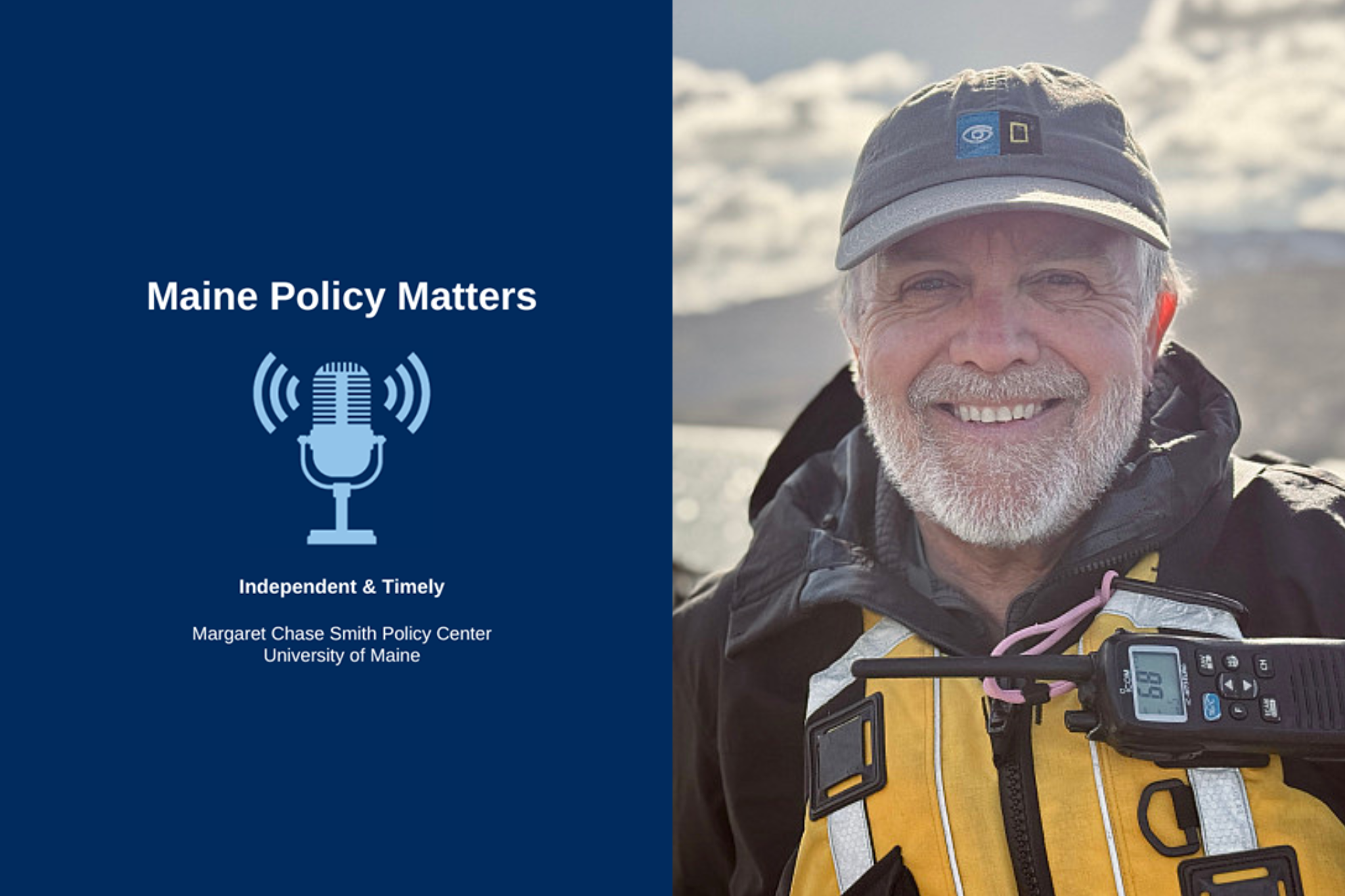
S8E2 The Future of Whales in Maine: Science, Policy, and People
In this episode, we explore the critical role whales play in the marine ecosystem and how advances in research technology have transformed our ability to study and protect them. Our guest, Toby Stephenson, shares inspiring moments from the field, insights from recent population studies, and the challenges posed by a changing climate. We also discuss the importance of collaboration between scientists, policymakers, and local communities in shaping the future of whale conservation. Looking ahead, we ask what gives reason for hope and how Maine can continue leading efforts to protect these ocean giants for generations to come.
Transcript
[00:00:00] Toby Stephenson: The problem is with science, people get frustrated because they have, I think in the back of their head that science is telling everybody it’s correct. We’re right. We know what’s going on. And the message really needs to be, we’re always learning and we’re always refining things.
[00:00:25] Eric Miller: Hello and welcome back to Maine Policy Matters, the official podcast of the Margaret Chase Smith Policy Center at the University of Maine, where we discuss the policy matters that are most important to Maine’s people and why Maine policy matters at the local, state, and national levels. My name is Eric Miller and I’ll be your host today we’ll be interviewing Toby Stephenson on the vital role whales play in the marine ecosystem, their deep connection to Maine’s history, and how evolving research technologies, climate change, and collaborative conservation efforts are shaping the future of whale protection. Toby Stephenson is the captain and director of marine operations at the Ecology of the Atlantic, where he oversees waterfront operations and teaches seamanship and navigation. During the summer, he conducts large whale research operations in the Gulf of Maine and the Bay of Fundy with Allied Whale and is the operations leader and head drone pilot during their studies. During the winters, he works as a guide and lecturer aboard expedition ships in Antarctica as a zodiac driver and marine mammal specialist.
[00:01:28] Maine’s history is deeply intertwined with the ocean, and whales have been a significant part of that narrative. Maine shipyards and coastal communities have constructed vessels for whaling expeditions. The Gulf of Maine has historically supported a diverse whale population with species such as humpback, finback, minke, and right whales utilizing the area for feeding and migration. Whale research in Maine is a relatively recent endeavor compared to the state’s long history with these marine mammals.
[00:01:56] While the region has been a focal point for whale observation and commercial whaling for centuries, a dedicated scientific study of whales in Maine began to emerge in the latter half of the 20th century. Pioneering research efforts in the state often coincided with growing public concern over declining whale populations and increasing human impacts on marine ecosystems.
[00:02:17] The College of the Atlantic has been instrumental in establishing long-term monitoring programs, studying whale behavior, population dynamics, and the effects of environmental changes. The College of Atlantic’s Oceanfront campus provides an excellent gateway for students and faculty pursuing marine science.
[00:02:34] Every summer teams of students and faculty conduct research on seabirds, whales, seals, and island ecology on our offshore research stations. Students also work with Allied Whale, the College of Atlantic’s Marine Mammal Research Group, and have access to boat and waterfront resources. Many students go on to do internships and conduct research from the Arctic to the Antarctic, on every continent and in the oceans and seas around the globe.
[00:03:01] Contemporary research has significantly advanced our understanding of these animals and their critical role in the marine ecosystem. New studies on whale behavior are important because they are rare and provide updated insights into everything from population distribution to behavior, to changes in food sources that the whales and other marine mammals rely on.
[00:03:22] And now our conversation with Toby.
[00:03:29] Hi Toby. Thanks for joining us today.
[00:03:31] Toby Stephenson: My pleasure.
[00:03:32] Eric Miller: How do whales play a crucial role in the marine ecosystem, and how are they important to Maine’s history?
[00:03:38] Toby Stephenson: Well, I’ll a answer the second part first, in Maine’s history, there’s really, there’s been a little bit of shoreside whaling for the state of Maine.
[00:03:48] There hasn’t really been a lot of whaling, so to speak. Not like the Nantucket whalers, but this area was heavily hunted. So the whole New England region was a big whaling ground. The North Atlantic right whales were certainly hunted in this region historically, as were many of the other species. So whaling again, during that time, the population of Maine really wasn’t super big.
[00:04:14] It wasn’t at its highest, but whaling was very important regionally to other areas, and it certainly, historically, the Basques were hunting whales hundreds of years ago, maybe not into the actual Gulf of Maine, but certainly in the western North Atlantic. And because of whales’ presence, they do play a vital role in nutrient cycling and by their consuming of organisms low in the food chain or the food web, they take many of the nutrients that those organisms consume, digest them and then put that material back up in the surface of the water column, and that is, that’s a really critical role in the nutrient cycling.
[00:05:00] Eric Miller: Fascinating. I love the way that an animal like that can get so big feeding on something so small and then the redistributive of effect that they have of nutrients in the ecosystem is really something. How has technology for whale research evolved and how has it improved your ability to study and protect whales in the more recent years that you’ve been working?
[00:05:21] Toby Stephenson: The technology is exceeding at vastly expedited rates. It seems, understandings of our historical sort of cycling of biomass. Most of that information was taken from old whaling records. Back in the, the early 19 hundreds, scientists were going out on ships and collecting data alongside the whalers, and they would, biologists would be on board, measuring heart size, measuring stomach contents, measuring just general morphometrics of an animal, meaning their body length and width and length of flippers and things like that. So they’re collecting all kinds of data onboard these ships that as a result of a decline in whales.
[00:06:09] So a little bit, sort of a history of whaling prior to the late 18 hundreds, early 19 hundreds, whaling had been a very manual process. Sailing ships were going out and hunting whales. The big whales, like the finbacks and the blue whales weren’t ever hunted. They were targeting the sperm whales and the right whales because they were generally predictable and slow moving. Right whales, of course, were hunted because they were easy targets.
[00:06:38] When you killed them, they floated and it made them very easy to hunt several of the animals and then go back and collect them later. Sperm whales were hunted, of course, for the spermaceti in the forehead. And that was sort of prized oil, but it was a really slow process. It took hours and hours to hunt a whale and to finally dispatch the animal.
[00:06:59] And it was a pretty horrible process. What they would do is harpoon the animal, tire it out. They’d have it harpooned and tied to the boat and just like a fishing line with a big fish. That would eventually, if it can’t break the line, it would slowly get more and more tired, come to the surface.
[00:07:17] And then they’d have these big lances and they’d stab the whale. With these long lances, they’d get up really close to it and eventually it would start spouting blood through the blow hole. And they, the old Nantucket ears would holler out like “fire in the chimney”, and then they knew the animal was done.
[00:07:34] And then you’d bring it alongside the ship and they’d slowly take it apart. And then in the near the turn of the century mechanized ships started to come into fashion, and then the harpoon cannon was invented, which was ironic because it fastened or hastened the death of the animal. And made it much more humane, but it enabled them to hunt these animals at exponentially higher levels and animals like the fin whale went from being completely ignored to being the most hunted whale in the oceans, where over 400,000 individuals were taken.
[00:08:10] So the technology changed rapidly, and that’s when scientists began to go out on board. The boats. We started to see that the numbers of these animals were declining and people were concerned about overfishing, over harvesting. So they started putting scientists on the boats to try and understand what was going on because they had an idea that they were gonna run down the resource. And there’s, we have a long history of that. The world has driven fisheries resources to near extinction over and over again, and so was the case with whales and the scientists were able to collect all sorts of data and things like stomach contents and stuff like that, but it was all very rudimentary.
[00:08:50] And our understanding was really quite limited. Today with our modern methods like the use of drones, the use of digital tags, which are these incredible tags, that very small tags, they have hydrophones on them. They have GPS positioning and they have accelerometers inside of them that measure all of the movements of an animal on a 3D space.
[00:09:13] So you see pitch, roll and yaw, that’s the lateral movement. And you can then download that data and recreate the movements of an animal underwater. And when I was a young student at the College of the Atlantic, that’s what I used to imagine and fantasize as a whale watch naturalist. I wish I knew what they were doing underwater. And lo and behold, two or three years later, somebody from Woods Hole invents this d tag or this digital tag, and we’re now able to see exactly all of their movements and then superimpose that over bathymetric maps and add survey data of actual bait or prey in water, the krill or airing biomass. So you can literally see how they move and how they manipulate their prey in the water.
[00:10:00] It’s fascinating. And it continues to expand. We’re part of a, an interesting publication a few years ago where with a drone I observed a mother and calf feeding. We were, I was just flying the drone and I noticed something interesting in the water, but I had to go back and check the actual images later, the video. And I could see that a mother was lunge feeding under the surface of the water, but we never saw anything above the surface.
[00:10:28] If you were on the boat, you wouldn’t have seen a thing. It was only because the drone happened to be right over the head of the mother feeding, that we could see her lunging just below the surface of the water, maybe a few feet below the surface, never breaking the surface until she came up to breathe.
[00:10:44] And we also noticed there was a calf right alongside her doing the same thing and the calf was mimicking the mother. But that never would’ve been observed unless we happened to have a drone right in the exact spot, the perfect place at the perfect time. So very fascinating stuff.
[00:11:00] We did some research and found a paper from Antarctica where scientists had put D tags on a mother and the calf, and they were actually able to see the movements of the mother underwater feeding and the movements of the calf, learning the mimicry, or learning by mimicry, what the mother was doing, and then we were able to actually present the video of that actually happening. They were never able to see it visually. They could see it electronically or digitally, but we were able to actually add for the first time the confirmed observations of it.
[00:11:40] Eric Miller: That’s amazing. I am curious about the overfishing point that you were talking about too. The ocean is such a vast frontier, and thinking about the technology that they had back in the day, do you happen to know when they started realizing and how they started realizing that they may be overfishing certain whale populations? Was it just ships were out longer and they were catching less, or was there something else that indicated that?
[00:12:07] Toby Stephenson: It’s always been an ongoing realization because the Nantucketers used to hunt right in their door yards, right, right off the beach out of Nantucket, and the whales were really just in a, within a decade those numbers were down.
[00:12:26] So they had to go to other places and people knew that was happening and there was news publications and local newspaper articles. There were these conversations that the whales are being hunt-over hunted. So it’s nothing new. We’ve always known that was happening. It’s just what is more popular.
[00:12:46] And at the time and of course whale oil is very popular, so that’s what people are paying attention to. They’re not necessarily concerned about, oh yeah, we don’t have whales in our backyard. They’ll come back one day, ’cause of course, eventually they will if you leave them alone. But the realization of it is just ignored for the most part.
[00:13:05] And we knew that right up into the 1970s until finally the big boycotts and the numbers of whales were being driven so low that Congress had to step in and do something. But generally, it’s kind of a tragedy of the commons where you have a resource and you have this slow pecking away at it. People are aware of what’s going on and there’s outcry against it, but it depends how much there is and if it is dwarfed by the need and the want for the resource, it just disappears into, into the background noise and people continue to do what they want to do.
[00:13:45] So we’ve been aware of decline. There have been people that are observing that have been aware of declines as long as the declines have been happening. It’s just that no one was really listening to them and it was just being overshadowed by the excitement of what we can do with the resources that we find and the new resources when we’ve depleted these. So ships just had to go further and further until they finally, there was virtually none to be found. And the sperm whale numbers were in such decline where over 90% of the, it’s estimated 90% of the sperm whales were taken from the ocean.
[00:14:24] It just happened to coincide with the discovery of crude oil and that just sort of slipped in behind it. And then everybody forgot about the whales until the 1970s. They were hunting them for food and protein and no longer for oil. Then we finally did something about it on a national scale, but that was not a global scale.
[00:14:44] There were still countries that were hunting whales. So it’s funny, we’re always aware of these things. It’s just how much we want to, or what we want to do about it.
[00:14:54] Eric Miller: That’s so interesting and the point about discovery of crude oil as a substitute in the economic sense is amazing.
[00:15:02] Toby Stephenson: Yeah. Nobody thinks about whales and the need for oil to light your lamps and keep your lighthouses going and keep all of your factories’ machinery lubricated because it’s just been replaced.
[00:15:14] Eric Miller: You were talking about some studies that you, and some of the technology you’ve been using to observe these amazing creatures. What are some of the regular long-term monitoring programs you do and what are some of the more specific or niche kinda studies that you’re working on?
[00:15:30] Toby Stephenson: Well, so the lab that I’ve been involved with, and I, my time is starting to diminish now, and I’m moving on to other projects, but the lab that I work with at the College of the Atlantic has been involved in two long-term studies and they’re identical studies. One was begun in early two thousands and that was to look at where fin whale, humpback whales, minky whales, sei whales were feeding in the trophic scale. We really just got data on humpback and fin back whales and what we were doing was collecting skin samples from these two species of what we call rorqual whales, or these are the whales that lunge feed and they’re, when you see them, their throats balloon out and fill with water and they’re feeding on anything from small krill to herring or schooling fish. And we wanted to know where in the trophic scale they were occupying their time.
[00:16:39] And so we, by looking at the skin, a, our lead scientist Sean Todd did his graduate work at the university in Newfoundland, Memorial University. And he was looking at the isotopes in the skin of the whales because essentially you are what you eat and therefore what you eat is gonna be in your body.
[00:17:04] And the nitrogen isotopes of the food in the, that these animals are eating makes it to the skin for a short period of time. But we can see signatures of the food by taking skin sample. So we collect the skin sample and we look at the nitrogen isotopes. And we can tell if it’s nitrogen from krill or nitrogen from herring or capelin or whatever it is that we are sampling.
[00:17:35] And so you have to sample the food first, and then you can look at the skin and you basically compare them and you can see the molecular signatures. And it turned out after about a, I think it was a seven to eight year study, it was close to 10 years that the fin whales tended to occupy the lower trophic scale and humpback whales occupied or spent more time in the higher trophic scale, meaning fin whales were feeding on krill and more, and humpback whales were feeding on fish more. It doesn’t mean ’cause they both feed on the same, fin whales will feed on schooling, fish, and humpbacks will feed on krill. But in the Gulf of Maine, they tended to separate and they occupied these different environmental niches.
[00:18:26] That was an interesting study and that study was actually only just recently published. Actually, the data was sitting dormant for quite a long time, but it got published and that’s great. In the later 2000s, after the Gulf of Maine Marine Research Institute, GMRI, published a study, Andy Pershing published a study, I think it was in 2010 or 2015, that the Gulf of Maine was one of the fastest warming bodies of water on the planet, we decided to, or Sean, decided to redo this study. And look at that same study in comparison to the warming of the Gulf of Maine. So we’ve been collecting skin samples and we’re still analyzing that and we don’t know actually what the results are, but those results should publish probably within the next few years.
[00:19:21] But an interesting thing happened during this study. So we had these two identical studies. One in the early 2000s, and then another one later 2000 teens, where we are looking at how that has changed over time because the Gulf of Maine is warming. But in that time, as the Gulf of Maine was warming, we were having a harder and harder time finding whales. We had to end up spending the last four years of our study, I’ve been driving our research boat up into the Bay of Fundy to find whales because we, between 2015 and 2021, we were seeing virtually no whales around our study area in the Gulf of Maine, which is out of Bar Harbor.
[00:20:05] We run our research boat out of Bar Harbor and there are virtually no whales, so small Island Mount Desert Rock, which is the most remote lighthouse on the coast of Maine, we have students out there. During the summer observing marine mammals. We have a seal population out there, but we also have whales that would come and feed in the area and people stand in the tower, and they’d really been doing that since the 1970s when Allied Whale started working there under Steve Katona and it was a pretty popular spot to go watch whales and observe them from shore. But within that time period between 2015 and 2021, we were seeing almost no whales in the area and our research had to go up into the Bay of Fundy to find whales and to actually get any measurable data.
[00:20:51] Since then, whales have, there’s been some interesting phenomenons occurring while the Gulf of Maine was the fastest warming body of water the last year and a half, it’s actually been on a cooling trend, or at least the bottom water, the deep water’s been cooling. And that may be attributing to why we’re seeing whales actually starting to return.
[00:21:09] So contrary to the publication I provided, which was based on sort of 2003 data, since then, we’ve actually started to see a trend upwards, which hopefully is reversing the trend of no whales. And we might start to see whales begin to return. But again, this could be just sort of a short phenomenon.
[00:21:30] Eric Miller: How would you capture the skin cells?
[00:21:32] Toby Stephenson: We collect them with crossbows. We basically shoot them with a dart. If you can imagine a pencil where you take the eraser out of the end of the pencil, you have this hollow metal tip. That’s what the end of our dart looks like. And then we put a float on the end of it as well, and that float acts as a stopper.
[00:21:54] It prevents the dart from going in further than we want it to. We want it to go in about three quarters to an inch in depth to get a good sample. And then it bounces out and floats on the water and we can collect it. So we use a crossbow, we shoot them with a dart or a bolt and it hits, the animal, bounces out, and then we collect the bolt and pull the plug out of it. We want the skin and we want blubber because we’re also looking at toxicology in the animals.
[00:22:26] Eric Miller: So cool. I love the creativity and how clever science can and needs to be sometimes where you have this whole system of data collection and processing where from a crossbow to isotope measurements that you need all of that technology to, and you’re able to infer their behavior, a feeding behavior through that process, which is so cool.
[00:22:54] Toby Stephenson: Yeah. It seems sometimes so obscure where you can get that information. Yeah.
[00:23:00] Eric Miller: So you mentioned the Gulf of Maine being one of the fastest warming bodies of water due to climate change. And you underscore the importance of constant measurements in that we keep learning new things about the thermal dynamics of the water body and the little bit of cooling that could be happening toward the bottom.
[00:23:20] How else has climate change affected the whale population in the Gulf of Maine specifically, but in whale populations you’re observing more broadly too.
[00:23:29] Toby Stephenson: The warming in the Gulf of Maine has affected things in pretty strenuous ways. We started seeing, well, I say we collectively, the marine mammal world, started seeing the disappearance of right whales in the early two thousands, 2010 or so, maybe a little earlier.
[00:23:49] Fewer and fewer, fewer right whales were going up into the Bay of Fundy. So up in the Bay of Fundy, the northern part of the, or the northeastern part of the Gulf of Maine around Graham and Ann Island, between Nova Scotia and Graham and Ann Island. The right whales numbers’, which used to be very abundant.
[00:24:08] You could go up into the Bay of Fundy on a whale watch and see as many as 20 or 30 right whales in an afternoon. Those numbers started to decline and they were seeing fewer and fewer right whales. Simultaneously, they were seeing also a reduction in copepods, which are the primary food source, the exclusive food source of the North Atlantic right whale.
[00:24:34] We were seeing those right whales show up above Nova Scotia in the Gaspe Bay that actually ended up precipitating a whole new problem because the fishermen in the Gaspe Bay weren’t really used to right whales being around and they started getting entangled in all of their crab fishing gear and their other vertical lines in the water, and and created a whole new problem.
[00:24:58] But we were seeing the decline of right whales in the Gulf of Maine over about a 10 year period and and to virtually none. By 2015 to 2020, the only right whales that we were seeing were down off of Cape Cod over the over the winter in the spring and way up in the Bay of Fundy, where they used to see 20 or 30 or 40 in a day. They were seeing zero.
[00:25:26] Now, it doesn’t mean that the whales weren’t there because we were getting a lot of acoustic soundings or recordings of right whales in the Gulf of Maine. And on occasion we would see random ones here and there, but nothing significant. They were really just passing through onto other more productive feeding grounds.
[00:25:45] Since then again, things may be changing back in another direction. It’s hard to know because things do seem to be changing quite a bit, but we’re observing now that the right whale population has really declined in the Gulf of Maine itself, and likely due to the warming waters and the reduction of copepods, the tiny foods that they rely on.
[00:26:10] Eric Miller: Really interesting. And the interaction between the fishermen and an incoming animal that they’re now used to having around, in their, in, in their grounds is really interesting. Really interesting. And the interaction between the fishermen and an incoming animal that they’re not used to having around, in their, in, in their grounds is really interesting.
[00:26:35] Toby Stephenson: And to more to your answer. So the acoustics have become a really important part. So when we’re talking about technology, the acoustics that we’re able to now use in anywhere in the oceans have become really critical. So now we can put passive acoustic recording devices. You can sit them on the bottom and then recover them later.
[00:26:55] One really cool advancement in technology are pop-up devices, and this is where you have a buoy that you sink, you let it sit on the bottom, so maybe it’s weighted down with a cinder, with a anchor or a heavy piece of concrete or steel, and it sits on the bottom recording just by itself, quietly recording away whatever happens to pass by.
[00:27:17] And you can actually program the recording to target certain frequencies and sound waves so you can ignore the stuff that you don’t want to hear, maybe ship traffic or something like that. But you can focus on the sound frequencies that you do want which could be whale vocalizations, which range quite a bit.
[00:27:36] Then, later on you come by, you take a hydrophone and a speaker, you put it in the water, and you send an acoustic signal to the device, and the device wakes up. And it says, okay, yep, I’m here. And then you send a, another signal that says, burn your wire, right? Or turn the screw, whatever the device is, it triggers a release that lets the buoy disconnect from its anchor, and then it floats up to the surface.
[00:28:10] You collect the buoy and then you download, maybe a year’s worth of data that’s been recorded on it. Other examples of that are having a surface buoy always connected to it, and you’re actually getting real time data sent up via satellite and we can hear recordings of animals. So there’s many ways of listening now in the oceans and knowing what’s going on.
[00:28:36] Eric Miller: So as a public policy podcast, we have to bring it into that sphere a little bit, of course. So how do you see the collaboration between scientists, policymakers, and the public as we advance whale conservation and research efforts in the upcoming years?
[00:28:52] Toby Stephenson: Right now, I feel like they’re not talking. Policy makers aren’t, they’re really just want to hear what they wanna hear, and they’re not listening to the technology and the science.
[00:29:02] So not everybody’s like that. And there are people that want to connect the dots, but it’s, everything seems so estranged and biased right now. It seems really quite grim. But it doesn’t need to be that way. And I think organizations like NOAA and their Northeast Science Center or the, the various science centers they have around the United States, the data that they are producing, the science they’re conducting is really valuable.
[00:29:34] The problem is with science, people get frustrated because they have, I think, in the back of their head that science. Is telling everybody it’s correct. We’re right, we know what’s going on, and the message really needs to be, we’re always learning and we’re always refining things. The scientific process is always been about, this is what I’m witnessing, this is what I’m observing. This is the data that I have in hand. But that data either may change or I may make improvements to how I gather that data and refine and improve the information that I’m collecting. It’s like medicine. It’s exactly like medicine where we don’t really know much at in the beginning. Then we learn some things about it and we make some conclusions, and we often find those conclusions are good for some people and hurt other people, and we realize, oh, this is a good medicine we produced, but it produces counter effects that we couldn’t anticipate.
[00:30:49] And we realize now that, maybe three quarters of the people benefit, but 25% actually suffer. So we have to do something about that, and that’s what we’re constantly doing. Science is never giving you an answer. It’s only giving you the best information that we have now. And it’s always promising to try and make improvements on that.
[00:31:16] But it never gives you the ultimate answer to things. It only gives you a process that corrects itself constantly.
[00:31:28] Eric Miller: Yeah. And to me, it seems like one of the most natural human things we can do is the natural curiosity that we have to tinker and observe and just try to constantly learn more.
[00:31:39] Toby Stephenson: Yeah, we’re always trying to make things better as we go, and sometimes we make catastrophic mistakes in those new directions, and other times we make really great improvements, but policy and people have a really hard time sometimes getting that message and having enough patience to realize that we don’t really know, we’re just getting closer.
[00:32:04] Eric Miller: Thank you so much for hanging out today and chatting about whales and your work. As we close out, I’d love to hear a story about inspiring moment or something that you fondly look back on, as well as what gives you hope about the future of whale research and conservation in Maine and beyond.
[00:32:20] Toby Stephenson: Sure. My defining moment was when I was in my early twenties and it was before I, I was actually late at going to university, but, I was working at a summer camp and I was instructing kayak building actually in a weird way. But some friends of mine, and I heard about this whale that was locked up or sort of netted into this place called Lowell’s Cove.
[00:32:45] The fishermen had the mouth of the cove netted off to catch the menhaden that were in the bay, and there happened to be a young whale in there with the menhaden and trapped as well, and it was a big area. So there’s plenty of room for both. They just left the whale in there. The whale was feeding on the menhaden and the fishermen were collecting the menhaden.
[00:33:06] It was a great relationship while it lasted. So we had this captive whale at Lowell’s Cove and we went down there, we snagged a canoe from the camp and went out there in the early morning to see if we could find this whale. And we we went out at probably about four in the morning. The sun hadn’t come up yet and it was still quite dark.
[00:33:26] And there was mist on the water. And then we heard this blow and the sun is slowly starting to rise. The light is starting to change gradually, and then we hear this crack on the water and we start getting pretty excited. We’re not sure what it was, but we were getting pretty excited. And then all of a sudden, this young humpback whale about 20 feet off the bow of the canoe gives us a full breach and it comes up out of water. I can see its eye, I can see the water streaming off its body, its flipper and everything, and it does this beautiful sort of roll in the air as it comes out of the water with its sort of one side facing us and then it lands on the other side as it does this 180 in the air.
[00:34:12] And I ended up just being mesmerized and impacted by that animal and that experience. I went back to work and then every moment I had to read about whales, that’s what I did. And that’s what ultimately in the direction I’m in now, that was a really really moving moment or time. And that’s, everybody kind of has those little moments that, that stick with them.
[00:34:38] That was fine, but it was pretty incredible for me.
[00:34:42] Eric Miller: And you managed to not capsize the canoe with a breaching whale.
[00:34:45] Toby Stephenson: And we did not capsize the canoe and the fishermen were there and they said, okay, you’ve had enough. Now get on outta here. So we left with big grins from ear to ear. It was pretty fun.
[00:34:59] Eric Miller: And what gives you hope for the future?
[00:35:02] Toby Stephenson: Well, I’m gonna go back to one of your earlier questions about some of the technology because there’s one really important thing that I haven’t talked about and that is the citizen science. And the photo identification of whales, and there’s this incredible software out there now, the a fellow by the name of Ted Cheeseman has produced this matching software and anyone can participate in it.
[00:35:27] It’s called Happy Whale. You can take photos of whale tails and send them into this program and come back with history results. So they, with this AI technology, they can, they can match the tail, and with incredible accuracy and give you information about that animal. What’s so wonderful about this is that people, anyone, anywhere in the world can participate.
[00:35:54] If you see a humpback whale and it lifts its tail up, you can take a picture. Send it into, can either send it into the College of the Atlantic to Allied Whale and we’ll take care of it for you. Or you can send it into Happy Whale and they’ll match it for you and send you the information about when it was first cited, when it was most recently cited, does it have calves or has it had calves, and so on. So the database for collecting whale photographs has shot up exponentially to, we are starting to see so much data now from whale observations and sightings around the world that we’re starting to now get these macro trends and whales, and we’re starting to see much more details about their population growth or decline.
[00:36:45] But it’s getting humans involved on a level that’s never been seen before, and I’m really hopeful that type of work is starting to show that science and policy and humans can actually have a relationship and literally interact together and be a part of the same thing science used to be. You know something that was locked up in a laboratory somewhere and people with white coats were the only people that had anything to do with it, and everybody else just got the information when they got it.
[00:37:25] But you, Eric can go out on a whale watch boat and you can go collect data or a photograph and submit it to a very active, large database and be a part of that science. And I think that engagement is profoundly important to where we go with the world and how people actually respond. It just hasn’t gone far enough yet.
[00:37:55] We need more and more of it, and citizen science is happening on all kinds of levels around us. It just needs to expand more.
[00:38:03] Eric Miller: That’s so fun and I’ll keep that in mind. Next time I go on a whale watch, I can call myself a whale research citizen scientist and contribute.
[00:38:12] Toby Stephenson: Everybody can be a part of it now.
[00:38:14] Eric Miller: We’ll have a couple links to those resources that you just mentioned there, and I’ve learned so much. Thank you. Thank you for joining us.
[00:38:22] Toby Stephenson: Eric I appreciate it. Thank you very much.
[00:38:26] Eric Miller: If you enjoyed this episode and the previous discussions we’ve had on this podcast, please consider donating to the Maine Policy Review by visiting the journal’s website linked in the description.
[00:38:36] Our team includes Barbara Harrity and Joyce Rumery, co-editors of Maine Policy Review, and Jonathan Rubin, director of the Policy Center. Special thanks to professional writing consultant Kathryn Swacha, technical writer, Nicole LeBlanc, and podcast producer, editor, and writer Jayson Heim. Our podcast music is composed by Nathanael Batson.
[00:38:56] Visit MCS library.org to learn about Margaret Chase Smith, the library in our work in public policy and education. Find episode materials, the full transcript and resources in the description of this episode and on the Maine Policy Matters website. Share your topic ideas via the form on our website and follow us on Facebook, LinkedIn, and Instagram.
[00:39:17] You can find all of our episodes wherever you find your podcast, and thank you for listening.